
Hyperextension Benches & Roman Chairs
Hyperextension benches and Roman chairs strengthen the lower back, glutes and hamstrings through controlled extensions. Choose 45-degree hypers for home gyms or horizontal Roman chairs for heavier, commercial-style back work.
Check the pad and foot-plate adjustment range so the hip pad sits right at your hip crease. For more core and posterior-chain options, see ab and sit-up benches and ab and back machines.


-
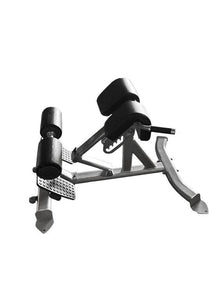 Up to 17% offVendor:Muscle D Fitness
Muscle D Fitness Hyper Extension Bench
In stockSale price From $825.00 USD Regular price$995.00 USD -

 Up to 23% offVendor:Body-Solid
Body-Solid GRCH322 Roman Chair
In stockSale price $515.00 USD Regular price$670.00 USD -
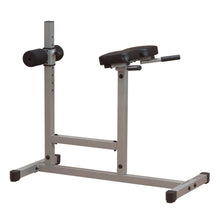
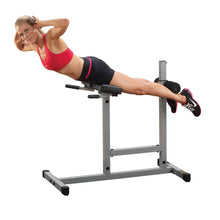 Up to 42% offVendor:Powerline by Body-Solid
Body-Solid Powerline Roman Chair Back Hyperextension PCH24X
In stockSale price $165.95 USD Regular price$285.00 USD -
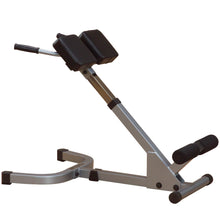
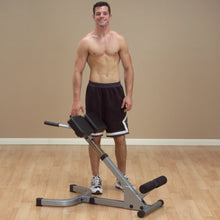 Up to 19% offVendor:Powerline by Body-Solid
Body-Solid Powerline 45 Degree Back Hyperextension PHYP200X
Low stockSale price $240.00 USD Regular price$295.00 USD


Frequently asked questions
What is a GHD and what does it train?
A GHD (glute-ham developer) is a padded station with foot plates and thigh/knee pads that lets you perform glute-ham raises, back extensions, and GHD sit-ups. It trains the entire posterior chain — hamstrings, glutes, lower back, and abs — through movements that no other machine can fully replicate. A staple of CrossFit, athletic training, and serious strength programs.
GHD vs. hyperextension bench — what's the difference?
A hyperextension bench (often called a Roman chair) is simpler and cheaper — you lie face-down with your hips on a pad and perform back extensions. A GHD is larger, adjustable, and lets you also do glute-ham raises (a brutal hamstring exercise) and GHD sit-ups. If your budget allows, get the GHD — you can do everything a hyperextension does, plus much more.
Is the GHD a dangerous piece of equipment?
It has a learning curve. GHD sit-ups in particular can strain the lower back if done with poor form or too much volume too soon. Glute-ham raises are extremely demanding on the hamstrings — start with partial range of motion before attempting full reps. Used correctly, the GHD is one of the most effective tools in any gym. Most programs limit GHD sit-ups to 20–30 reps per session early on.
What features should I look for in a GHD?
Look for: fully adjustable foot plate (accommodates different leg lengths and movement styles), adjustable knee/thigh pads (critical for proper positioning), wide, non-slip foot plates, and a stable, heavy-duty frame with wheels to move when needed. The Muscle D Glute/Ham Elite Series checks all these boxes.
Can I add weight to GHD exercises?
Yes — advanced users hold a weight plate or dumbbell across their chest during back extensions, glute-ham raises, and sit-ups for added resistance. Some GHDs include a band peg for resistance band attachment, which makes the eccentric portion of glute-ham raises significantly harder. Start bodyweight only until form is dialed in.
How much space does a GHD need?
Most GHDs have a footprint of about 4–5 ft long × 2–3 ft wide, with overall height around 3 ft. Allow an extra 3–4 ft of clearance on the head end for full range of motion on back extensions and sit-ups. Smaller than most strength machines, but not something you'll easily tuck away.
Not sure which one fits your space?
Talk to our equipment specialists about fit, power needs and delivery before you buy, or plan it yourself with our free tools and calculators.
Expert Leg Training Advice
-

Leg Press Foot Placement: Where to Put Your Feet
Where to put your feet on the leg press for...9 min read -

11 Effective Hip Thrust Alternatives You Need to Try (2026)
Hip thrusts are glute-building powerhouses, but relying on a single...9 min read

