Bodybuilding Gym Equipment: What to Buy, in What Order
The bodybuilding gym equipment to buy and in what order: rack, bar, plates, bench, dumbbells and flooring, with rack heights, typical budgets and our Xmark pick.
The bodybuilding gym equipment you need starts with six pieces: a power rack, a barbell, weight plates, a sturdy adjustable bench, dumbbells and dense rubber flooring. The rack should have safeties, which are bars that catch the barbell if you miss a rep. Add cables or machines later.
If your ceiling is at least 90 inches (7.5 feet), our top pick is the XMARK Viper Power Rack Package. It covers the rack, bench, bar and plates in one order. You'll find it with our other home gym bundles.
Minimum kit: a rack with safeties, a barbell and plates, an adjustable bench, dumbbells and rubber flooring.
On a tight budget: start with the bench, dumbbells and flooring. Add the rack, bar and plates next. Save cables, a Smith machine and a full dumbbell set for last.
Key takeaways
- Buy in stages, starting with the bench, dumbbells and flooring.
- Pick a rack with safeties or spotter arms so you can train hard alone.
- Check your ceiling. The Viper racks need at least 90 inches (7.5 feet); the GPR400 stands 79 inches.
- Lay dense rubber flooring before the heavy gear arrives.
The short list: bodybuilding gym equipment you need
You want gear that loads every muscle group and lets you add weight over time.
The American College of Sports Medicine (ACSM) says to train all major muscle groups at least 2 days a week. For muscle growth, it suggests about 10 sets per muscle group each week. The kit below covers that.
| Item | What it does | When to buy |
|---|---|---|
| Adjustable bench | Presses, rows, incline work | Stage 1 |
| Dumbbells | One-arm and isolation work | Stage 1 |
| Rubber flooring | Protects floor and gear | Stage 1 |
| Power rack | Safe heavy squats and presses | Stage 2 |
| Barbell | Main bar for big lifts | Stage 2 |
| Weight plates | Load you add over time | Stage 2 |
| Cables or Smith | Extra angles and isolation | Stage 3 |
The first six rows cover almost every bodybuilding lift. The last row is an upgrade, not a must.
What to buy first: a build order by budget
Most of our beginners start with adjustable dumbbells or a barbell and plates. They add an adjustable bench, a power or squat rack with a pull-up bar, and dense rubber flooring.
Here's the order we'd suggest. The stages go by budget. The price ranges and setup times are typical for the market, and your total depends on brand and how much weight you buy.
Stage 1: starter (typically $300 to $1,000)
Get an adjustable bench and a basic set of free weights. Add rubber flooring under where the rack will go later.
This gear usually ships by parcel. One person can typically set it up in 30 to 60 minutes.
Stage 2: mid (typically $1,000 to $3,000)
Add a squat stand or half rack, a heavy-duty bench, an Olympic barbell and about 160 to 230 lb of bumper plates. Bumper plates are thick rubber plates.
This stage usually arrives on a pallet at the curb. Plan on 1 or 2 people and 2 to 4 hours of assembly.
A package can break the pattern. The XMARK Viper Power Rack Package includes a full cage, a bench, a bar and plates. It lists at $2,609, which falls inside this range.
Stage 3: full gym (typically $3,000 to $7,000 or more)
Move up to a full cage, a functional trainer or a Smith combo. Add a better bench, a dumbbell set with a rack, and mats for the whole floor.
Expect several pallets. Two people often need 4 to 8 hours or more, and white-glove setup is optional.
What buyers wish they hadn't skipped
We hear the same three regrets:
- Cheap foam instead of dense rubber. Dense rubber, like horse stall mats, holds up under heavy gear. Swapping foam later means moving everything off it.
- A rack without spotter arms or pipe-and-pin safeties. Without them, you can't safely push a set close to failure on your own.
- A cheap, narrow, wobbly utility bench. It often gets replaced with a commercial bench.
Power rack, half rack or squat stand: what fits your space?
All three hold a barbell for squats and presses. They differ in protection.
- Power rack (cage): four posts, with safeties on both sides. It gives the most protection when you train alone.
- Half rack: two main posts, usually with spotter arms in front. Smaller, with a little less coverage.
- Squat stand: two uprights and little else. The smallest and cheapest, but it often lacks long safeties.
J-cups are the hooks that hold the barbell on the uprights. Safeties sit below them.
Check your ceiling height
Height is usually the deal-breaker. A 7-foot ceiling is 84 inches, and 7.5 feet is 90 inches. Here's how some racks we carry compare.
| Rack | Height | Footprint | Rated for |
|---|---|---|---|
| XMARK Viper Package | 90 in | 48 in wide; depth not listed | 1,500 lb |
| XMARK Viper rack | 90 in | 48 in wide; depth not listed | 1,000 lb J-cups |
| Body-Solid GPR400 | 79 in | 53 x 52 in | 1,000 lb |
| Body-Solid PPR500 half rack | 83 in | 50 x 51 in | 700 lb |
With a 7-foot ceiling, only the GPR400 leaves real room overhead. The Viper needs a ceiling of at least 90 inches (7.5 feet).
Pull-ups need even more headroom, because your head goes above the bar. For walk-out room in front of the rack, use our home gym space requirements guide.
Our rack picks
The XMARK Viper Power Rack is the rack-only version of our top pick. It uses 3 x 3 inch steel and has numbered uprights, front and back. It comes with strap or flip-down safeties and concrete floor anchors.
One thing to weigh: the holes sit 2 inches apart, so you get fewer height settings than on a rack with 1-inch spacing.
The Body-Solid GPR400 is our pick for a 7-foot basement. At 79 inches tall, it leaves 5 inches under an 84-inch ceiling. It includes pipe-and-pin safeties, J-cups and a pull-up bar, with a lifetime warranty on all parts.

What it lacks: a bar, plates and a bench, because it's just the rack. Browse more sizes in our power racks.
Barbell, plates and dumbbells
Barbell and plates
The barbell does most of the heavy work: squats, bench presses, rows and deadlifts. The Viper package includes a 7-foot Olympic barbell and a 160 lb bumper plate set.
On a 48-inch-wide rack like the Viper, the ends of a 7-foot bar reach about 18 inches or a bit more past each side. Leave room past both ends so you can stand there and load plates.

You don't need every plate on day one. How many reps you can do depends on how heavy the weight is. Sets of 8 to 12 reps are often called the "hypertrophy zone." Hypertrophy just means muscle growth. A 2021 review found muscle gains can come from a wide range of loads, though. Lighter weight for more reps still works when you take sets close to failure.
Fixed or adjustable dumbbells?
Adjustable dumbbells are where many of our beginners start. One adjustable pair replaces a whole rack of fixed dumbbells, which suits a small room. The trade-off is time spent changing weights between sets.
Fixed dumbbells are faster to grab and simpler to use. A full set takes more floor and costs more up front, and you'll need a rack for it.
If space is tight, see our guide to compact home gym equipment.
What makes a good bench?
A bench takes every press and row you do, so it has to hold steady. Look for three things:
- A high weight rating that covers you plus the weight you're lifting.
- A wide, steady base that doesn't rock during heavy presses.
- Several back angles for flat, incline and shoulder work.
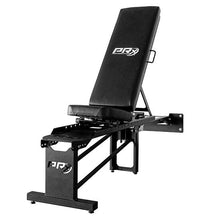
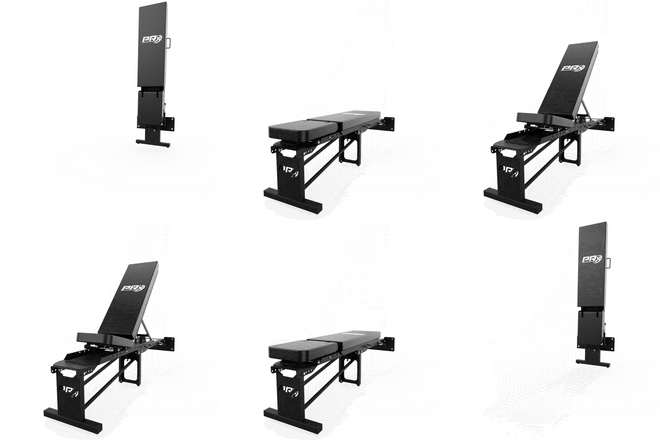
The Viper package includes an FID (flat, incline, decline) bench. If you buy a rack on its own, the PRx Profile incline folding bench is our pick.
The bench is rated for 1,000 lb and has a 2-inch pad. Gas shocks assist it. The seat sits 18 inches high, and PRx rates it for home and commercial use with a lifetime warranty.
Keep in mind: our listing doesn't show a decline setting. At 85 lb, this isn't a bench you'll carry from room to room.

Flooring and floor space
Put the flooring down first. Once a rack is anchored and loaded, swapping the floor under it is a big job. The regrets list above says why.
Lay dense rubber under the rack and bench before the pallets arrive.
How much floor space do you need?
Start with the frame size, then add the bench and the bar. Here's a rough estimate from our listings for a GPR400, the PRx Profile bench and a 7-foot bar.
- Rack: the GPR400 is 53 x 52 inches, about 19 square feet on its own.
- Bench: the PRx Profile is about 65 inches long when set up. Pulled out in front of the rack, it adds about 5.5 feet of depth.
- Bar: a 7-foot bar is wider than the rack, so the loaded bar sets the width at 7 feet or a bit more.
That adds up to roughly 7 x 10 feet, or about 70 square feet. Treat it as an estimate. It doesn't include room to walk around, step back or load plates.
Cables, pull-up bar and machines
You don't need a room full of machines to build muscle. Add these once the basics are set.
- Pull-up bar: many racks include one, like the Viper package and the GPR400. The catch is headroom, as covered above.
- Dip station: good for triceps and chest. The catch: one more frame to find floor space for.
- Functional trainer: a cable station for flyes, pushdowns and rows. The Body-Solid PFT50 has a 210 lb stack and stands 84 inches tall. It weighs 329 lb, so it stays where you put it.
- Smith machine: a bar that rides on fixed rails. Handy for training alone, but the fixed path doesn't suit every lifter.
Home-gym grade or commercial grade?
Most home lifters do fine with home-rated gear that has a high weight rating. Commercial grade makes sense for a garage gym shared by several people, or a small studio.
On our listings, compare three things: rated use (home, commercial or both), weight capacity and warranty. The Viper rack, for example, is rated for home and commercial gyms and has a lifetime mainframe warranty.
The XMARK Commercial Smith Machine is a commercial option. The machine is rated for 1,000 lb and has a lifetime mainframe warranty. It measures 40.5 x 64.5 x 88.5 inches.
The cost of that: it weighs 415 lb, and at 88.5 inches tall, it needs more than a 7-foot ceiling.

Safety basics
A rack's safeties only help if you set them. Follow your rack's manual for the right height.
- Safeties or spotter arms: use them for every heavy squat and bench set.
- Collars: clip them on so plates can't slide off one end.
- Anchors: the Viper racks come with floor anchoring hardware. Use it.
- Used gear: check the CPSC's exercise equipment recall list before you buy.
Frequently asked questions
Frequently asked questions
What equipment do I need for bodybuilding at home?
A rack with safeties, a barbell and plates, an adjustable bench, dumbbells and rubber flooring. That covers presses, squats, rows and isolation work for every muscle group.
Can I build muscle without machines?
Yes. ACSM found that machines versus free weights did not consistently change results for healthy adults. It also says home-based training can work.
Should I buy a package or build the gym piece by piece?
A package gets the core gear in one order. Piece by piece spreads the cost, and it lets you start with the bench, dumbbells and flooring.
Is a squat stand enough, or do I need a power rack?
A squat stand can work if you always lift with a spotter. If you train alone, a power rack or half rack with safeties is safer.
How much does a home bodybuilding gym cost?
Typical ranges climb from a few hundred dollars for a starter setup to several thousand for a full gym. The build stages above break them down. For reference, the XMARK Viper Power Rack Package lists at $2,609.
Which rack or bundle fits you?
Bodybuilding gym equipment comes down to a rack with safeties, a bar and plates, a solid bench, dumbbells and good flooring. Buy them in stages, starting with what you'll use every session.
- A ceiling of at least 90 inches (7.5 feet): the XMARK Viper Power Rack Package.
- You already own a bench, bar and plates: the XMARK Viper Power Rack on its own.
- A 7-foot basement: the Body-Solid GPR400, plus a bench, bar and plates.

XMARK Viper Power Rack Package
Power rack with 1,500 lb capacity, 90 in height, and flip-down safeties
Our top pick if your ceiling is at least 90 inches (7.5 feet). Plan on a helper, since it weighs 596 lb assembled. It lists at $2,609 and ships by freight truck, with 3 to 5 days in transit.