
Massage Guns
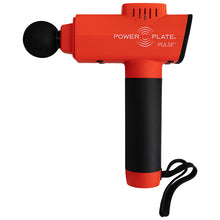
Massage guns deliver percussive therapy to loosen tight muscles before training and speed recovery afterward. Choose full-size guns for deep tissue work or compact minis for travel and gym bags.
Compare amplitude, stall force and battery life: stronger guns reach larger muscles, while minis trade power for portability. For hands-free recovery, see massage chairs or foam rollers.


-
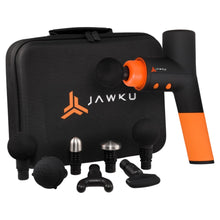
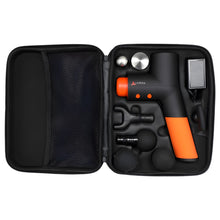 Sold out
-
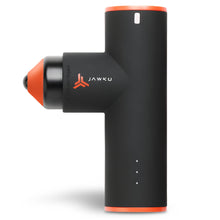
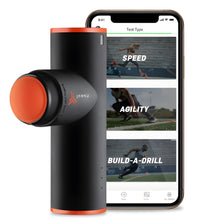
-
-


Frequently asked questions
What's a percussion massager and how is it different from a regular massager?
Percussion massagers (also called massage guns) use a motorized head that rapidly punches in and out 20–60 times per second with 10–16mm of travel depth. This "percussive therapy" penetrates deeper than traditional vibration or rolling massagers, making it much more effective at releasing tight muscles and fascia. Popular brands include Theragun, Hypervolt, and many commercial alternatives.
How do I know if a massage gun is high quality?
Three specs matter: stall force (40–60 lb for serious use — how hard you can press before the motor stops), amplitude (12–16mm of travel is best — deeper penetration), and battery life (2+ hours minimum). Budget under $100 guns usually compromise on all three. The $150–400 range is the sweet spot for home use.
How often should I use a massage gun?
Before training: 30 seconds per muscle group as a warmup (quick, light pressure). After training or on rest days: 1–2 minutes per muscle group at moderate pressure. Daily use is safe for most people if you stay off bones, joints, and sensitive areas. Avoid using directly on the neck (stay on shoulders and traps instead) and never on injuries or bruises.
What areas shouldn't I use a massage gun on?
Avoid: bony areas (spine, ribs, skull), the front or sides of the neck (can damage arteries), joints and tendons directly, recent injuries, bruises, or inflamed areas, and broken skin or varicose veins. Pregnant women should consult a doctor before use. Stick to muscle bellies (the meaty parts of muscles) and avoid pressing too hard on any area.
What attachments do I actually need?
Most guns ship with 4–6 attachments, but you'll use 2–3 regularly: the ball head (general muscle use — most versatile), the fork head (spine, Achilles, and along muscle lines), and the flat head (dense muscle groups like quads and glutes). Bullet/cone heads are for trigger points but require care — easy to bruise yourself. Skip any attachment you don't use within the first month.
Is a massage gun worth it over a foam roller?
They serve different purposes. Foam rollers are better for broad surface work, warmups, and general mobility — cheap, effective, no batteries. Massage guns are better for targeted relief, deep tissue work, and specific trigger points. Most serious trainees eventually own both. If budget is tight, a foam roller and lacrosse ball covers 80% of what a massage gun does at 5% of the cost.
Not sure which one fits your space?
Talk to our equipment specialists about fit, power needs and delivery before you buy, or plan it yourself with our free tools and calculators.
Recovery & Wellness Expert Guides
-

Red Light Therapy 2026—Pro Results & Safety Tips
Discover how red / near-infrared photobiomodulation boosts ATP, collagen, recovery,...4 min read
